
This is one of the most common questions that I am asked in lessons and the best answer is the good old tried and true K.I.S.S principle. understand what is needed and play it. Easy right? Not always but we will look at a few things that will help you on your way to playing great solos.
Now people always say you need to be at an advanced level to play solos. This is not true obviously if you are at an advanced level then you will be capable of playing a more difficult solo but this is no indication of weather the solo is good or not. The best example of this is “Mary had a little Lamb”. Four notes played at a steady pace without a lot of fanfare. Now this piece would only present a challenge to a very small group of people but most people would be able to play it fairly easily and quickly. Now the thing about this tune is it is memorable, sounds pleasing to the ear, and is recognisable. This is a great example of a solo.
First things first. We need a basic understanding of how chords sound with the notes we play. If you play one note over particular chord it may sound great but if you play another note it could end up sounding really bad. The reason why is that some notes just don't sound good together. How do I know what notes will work over what chords? Now we could get a friend to play a bunch of chords while you check and see what notes will work. Or an easier way would be to learn some scales and know what keys you can play them over.
Now before we jump in and learn a whole bunch of scales we need to understand what a key is. The best way to describe a key is to look at it like it is a bunch of notes that sound good together. This means that if we are playing the notes from a key and the chords that we are playing over are from the same key then theoretically this should sound good.
So what keys should we learn first? Well the best type of scale to start with is the Pentatonic scale. The reason why is because it only has five notes in it. So on any Instrument it is fairly easy to learn where five notes are on any instruments. I like to teach people three scale shapes and how they link together.
These shapes need to be learned so well that regardless of what note you are fretting you will be able to see how they link to the other two scales. You need to be comfortable linking them moving up the neck (towards the bridge) as well as moving down the neck (towards the headstock).
The scale shapes used here have two different colours marked on each shape. At first we will be focusing on the ones in black. These notes are the notes that most easily fit over the chords we will be using. Once you are comfortable using the black notes you can start to incorporate the red ones.
The numberings refer to which fingers should be used to fret the notes. For ease of reference, you should imagine that the guitar headstock is to the right-hand-side of the page and the first (high E) string is at the bottom of the diagrams.
These shapes are moveable and can be played anywhere on the fretboard. For best results, try to play them in as many positions as possible. Remember, the more thoroughly you learn these shapes, the easier it will be to use them in solos.
The first thing we need to do is learn the scale shapes and how they are linked. These shapes need to be learned so well that regardless of what note you are fretting you will be able to see how they link to the other two scales. You need to be comfortable linking them moving up the neck (towards the bridge) as well as moving down the neck (towards the headstock).
1. Minor shape one: The second note of this scale is the same as the first note of the next scale
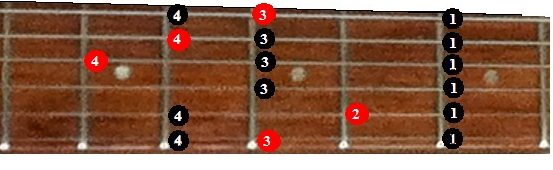
2. Major shape: The third note of this scale is the same as the first note of the next scale.

3. Minor shape two: The second note of this scale is one tone (two frets) from the first note of the fist scale. If the second note of this scale is on the 7th fret then the first note of the first scale will be on the 9th fret.

Now that you are familiar with the shapes and how they are linked, you need to find some note groupings that you like. A good solo is recognisable - you can hum along to it and most of the more memorable licks are very simple. Try to focus on a single idea with only four or five notes and then use the techniques mentioned earlier in this book to enhance them. You can also add other notes from the scale shapes to give it some variety. The more you do this the better you will get.
The key to playing good solos and creating great licks is to focus on the melody or tune you are trying to play. The stronger this is, the better your solos will be. Always hear the tune in your head and then try to replicate it on your guitar. If you can do this then you will be well on your way to playing guitar solos.
And this is just the beginning. Once you are fluent using the black and red notes while playing along with the CDs, experiment with using other notes outside the scale shapes to see how they sound. There are 12 notes that can be used in music – so why limit yourself to just five or seven?!
www.12strings.com.au
www.12strings.com.au/piano.html
www.12strings.com.au/guitar.html
www.12strings.com.au/bass.html
www.12strings.com.au/ukulele.html

